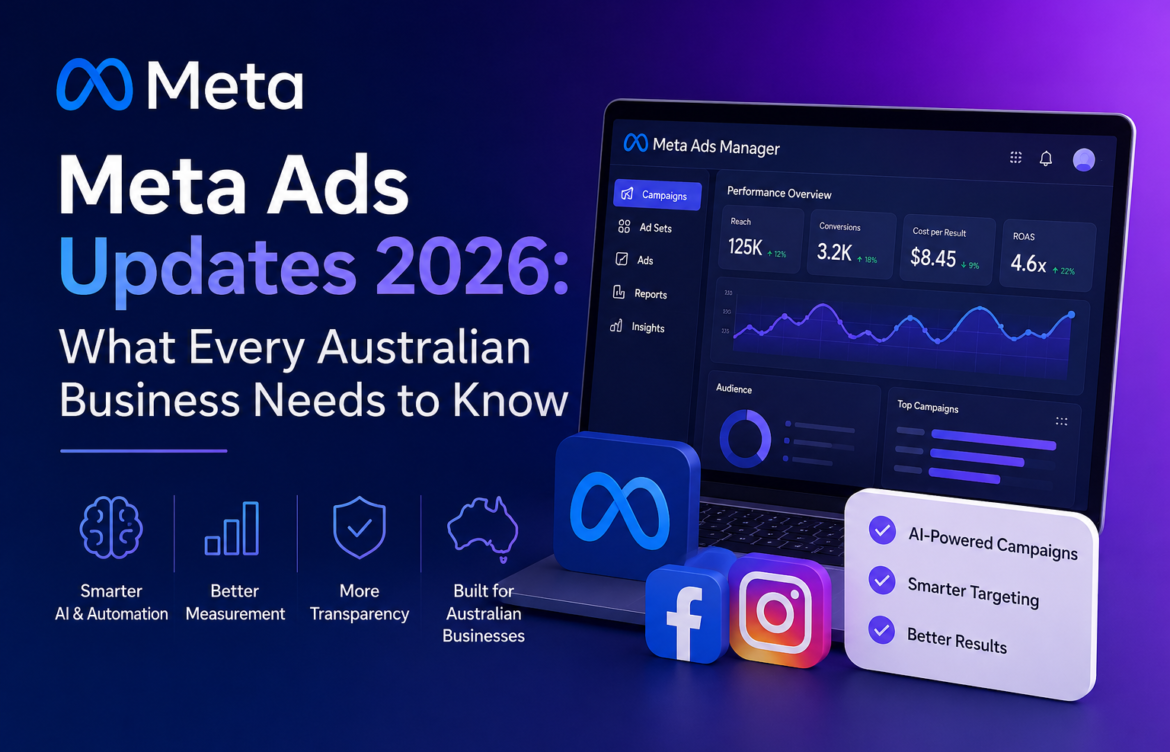
Meta Ads Updates 2026: What Every Australian Business Needs to Know
If you’ve logged into Meta Ads Manager recently and felt like something had changed — you’re not imagining it. Meta has rolled out a wave of significant updates throughout 2026, shifting its entire advertising ecosystem toward artificial intelligence, smarter automation, and more transparent measurement. For Australian businesses running ads on Facebook and Instagram, keeping up with these changes isn’t optional — it’s essential.
Here’s a comprehensive breakdown of everything that has changed in Meta Ads this year, and what your business should do about it.
1. The Andromeda Algorithm: AI Is Now Running the Show
One of the biggest under-the-radar shifts in 2026 is Meta’s deployment of its new Andromeda AI system. Unlike previous ad delivery models that relied heavily on audience-defined parameters, Andromeda processes ad signals at a vastly greater scale, using creative content itself as a primary signal for determining who should see your ads.
In plain terms: your ad creative is now doing more of the targeting work. Meta’s AI reads your images, copy, and video content and matches it to the users most likely to respond. This means businesses that refresh their creative regularly and maintain high-quality, varied content are seeing stronger results, while those running the same ads week after week are experiencing rising CPMs and declining reach.
What to do: Audit your creative library. Aim to rotate new creative variations at least every two to three weeks, and lean into video, Reels-style content, and authentic storytelling over polished, static graphics.
2. Attribution Has Changed — And Your ROAS Numbers Have Too
Meta has updated how it counts conversions in 2026. Click-through attribution now only counts genuine link clicks — meaning likes, shares, saves, and comments are no longer bundled into your conversion data. These engagement actions are now tracked separately under a new “Engage-through attribution” category.
The practical impact? Many advertisers have seen their reported ROAS drop noticeably — not because their ads are performing worse, but because the measurement is now more accurate and honest. A campaign that previously showed a ROAS of 4.2 might now show 3.1. The results are the same; the reporting is simply cleaner.
What to do: Recalibrate your internal benchmarks to reflect the new attribution model. Don’t panic if your numbers look lower — compare performance over time using the same attribution window, and focus on downstream business metrics like actual revenue and lead quality.
3. Advantage+ Is Now Open to Smaller Businesses
Meta’s Advantage+ Shopping Campaigns (ASC) — now more broadly referred to as Advantage+ Sales Campaigns — have become significantly more accessible in 2026. The conversion threshold required to run these AI-powered campaigns has dropped from 50 conversions per week down to just 25 conversions per week, opening the door for smaller Australian e-commerce businesses that were previously locked out.
Additional Advantage+ updates this year include:
- Predictive Budget Allocation: Meta’s system now dynamically shifts your spend across ad sets in real time based on predicted conversion probability, reducing the need for constant manual bid adjustments.
- “Describe Your Audience” tool: Advertisers can now write a plain-text description of their ideal customer, and Meta’s AI handles the audience targeting based on that input — no more manually building detailed interest-based audiences.
- Expanded audience controls: Despite the AI-first approach, Meta has also given advertisers more guardrails — including better controls over who is excluded from Advantage+ audiences, addressing a key concern from 2025.
What to do: If your business generates at least 25 conversions per week, now is the time to test Advantage+ campaigns. Start with a dedicated budget alongside your existing campaigns and compare performance over a four-week period.
4. New Placements: Threads Ads and Shoppable Reels
Two new ad placements have entered the mix in 2026, and early adopters are reaping the benefits of lower competition.
Threads Ads are now available globally via the Marketing API, giving brands access to Threads’ rapidly growing user base of over 400 million monthly users. Because most advertisers are still focused on Facebook and Instagram, CPMs on Threads remain comparatively low — making it a smart testing ground for awareness and engagement campaigns.
Shoppable Reels allow businesses to tag products directly within Reels content, creating a seamless path from discovery to purchase without leaving the app. For Australian retailers with a Facebook/Instagram shop set up, this is a high-priority feature to activate.
What to do: Allocate a small test budget (even 10–15% of your social spend) to Threads and shoppable Reels. Getting in early while competition is low gives your brand a meaningful advantage as these placements mature.
5. Smarter Tracking: AI Pixel Setup and One-Click Conversions API
Tracking has been a major headache for advertisers since iOS 14 changes disrupted third-party data in 2021. Meta has made significant strides in 2026 to bridge the gap:
- AI-powered Pixel setup now walks businesses through the installation process with intelligent guidance, reducing reliance on developers for basic event tracking.
- One-click Conversions API (CAPI) integration makes it far easier for businesses to connect server-side data without technical expertise — closing the data gap that has affected reporting accuracy for years.
- 730-day purchase audiences are now available, extending the lookback window for building retargeting audiences based on past purchase behaviour — a significant win for businesses with longer customer cycles.
What to do: If you haven’t implemented the Conversions API yet, 2026 is the year to prioritise it. The one-click setup removes most of the technical barriers. Better data in means better optimisation and more accurate reporting out.
6. Targeting Changes: Less Manual Control, More AI Trust Required
In January 2026, Meta removed several detailed targeting options — particularly those related to sensitive interest categories including political affiliations, religious beliefs, and certain health topics. This follows a broader trend toward privacy-first advertising that Meta has been building toward since 2021.
The loss of granular targeting has pushed many advertisers toward Advantage+ Audience — Meta’s AI-driven audience tool — rather than traditional detailed targeting. Early testing across the industry suggests that Advantage+ Audience frequently outperforms manual detailed targeting, particularly for e-commerce campaigns, though the results vary by industry and objective.
What to do: Run A/B tests comparing Advantage+ Audience against your existing detailed targeting setups. Let data guide the decision rather than defaulting to the familiar approach. For many businesses, the AI-managed option is already winning.
7. Location-Based Fees Coming Mid-2026 (International Advertisers)
For Australian businesses running ads targeted at international markets — particularly in Europe — it’s worth noting that Meta will apply location-based fees of up to 5% on ads delivered in Austria, France, Italy, Spain, Turkey, and the UK from mid-2026 onward. These fees are tied to Digital Services Taxes (DSTs) imposed in those jurisdictions.
If your campaigns target any of these markets, expect a modest increase in your effective ad spend and adjust your ROAS targets accordingly.
What This All Means for Australian Businesses
The overarching theme of Meta’s 2026 updates is clear: the platform is becoming a fully AI-driven ecosystem. Manual audience building, rigid creative strategies, and set-and-forget campaigns are increasingly less effective. The businesses that will thrive are those that work with Meta’s AI rather than against it — feeding it quality creative, clean data, and realistic conversion signals.
For Australian SMEs, these changes represent both a challenge and an opportunity. The lowered Advantage+ thresholds, simplified tracking tools, and new affordable placements mean that sophisticated, AI-powered advertising is no longer the exclusive domain of large brands with big budgets.
The key is staying informed, testing systematically, and adapting quickly as the platform continues to evolve.
Need Help Navigating Meta Ads in 2026?
At eMinds Academy Australia, we help businesses understand and adapt to the ever-changing digital advertising landscape. Whether you’re just getting started with Meta Ads or looking to sharpen your existing strategy, our team is here to support you with practical, results-focused guidance.
Get in touch with us today to find out how we can help your business make the most of Meta’s 2026 updates.